

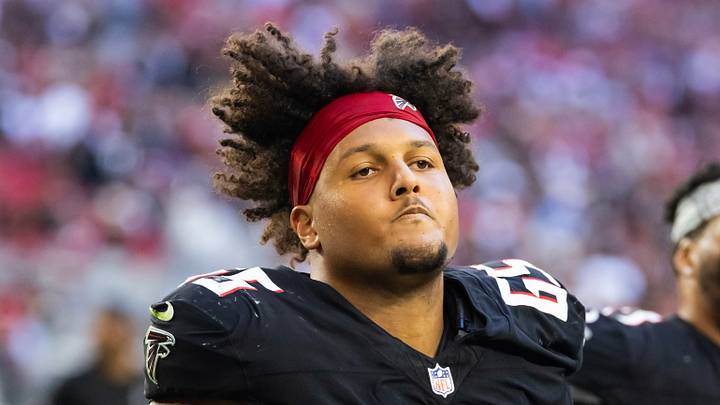
Matthew Bergeron is a good guard. And he was worthy of an extension. But Mathhew Bergeron is not one of the 2-3 best guards in the NFL. And he certainly did not warrant an extension that tied him for the second-highest paid guard in the NFL.*
The league has long paid for pass blocking more than run blocking. It's the harder skillset, play reactively and having to adjust to your opponent. Run blocking is a much more proactive endeavor allowing linemen to attack the defense. Bergeron has long been a run-first guard.
*Since his signing Peter Skoronski has ascended to the highest-paid guard, bumping Bergeron down to tied for third.
Bergeron posseses a skillset that doesn;t traditionally get paid
For lack of better publicly available measurements I am going to cite some Pro Football Focus grades to help illustrate a point that any NFL analyst will agree with. Bergeron's run block grades have outpaced his pass block grades in every season since he entered the league.
Over that same time period, Bergeron falls in the 24th percentile in pressure rate allowed (5.38%) and the 40th percentile in sack rate allowed (0.59%) among all guards with at least 750 pass block snaps. Overall, he's a playable pass protector who needs to rely on an o-line friendly scheme to help him out.
Compare that to some of the contemporaries his contract matches - Tyler Smith, Trey Smith - and the differences become stark.
Player | Pressure Rate Allowed | Percentile | Sack Rate Allowed | Percentile |
|---|---|---|---|---|
Matthew Bergeron (2023-2025) | 5.38% | 24th | 0.59% | 40th |
Trey Smith (2022-2024) | 4.31% | 53rd | 0.19% | 89th |
Tyler Smith (2022-2024) | 3.02% | 95th | 0.23% | 84th |
But as a run blocker, he is one of the better guards in the NFL. His snap-adjusted run block grade over the last three seasons falls in the 63rd percentile and it's arguably on the upswing. He's the perfect guard for new head coach Kevin Stefanski's offense and he helps ensure that the also recently paid Bijan Robinson has plenty of lanes to run through for years to come.
This isn't an argument that the Falcons shouldn't have paid Bergeron. But I do question paying him this much.
A fairer value for Bergeron
Looking at his closest comps and the picture really clarifies that Bergeron falls more towards the mid-tier of valuations. Here is a look at the two-year production for similar profile guards who have signed contracts recently.*
Player | Cap-adjusted APY | Age | Draft Round | Snaps | Pressure Rate Allowed | Sack Rate Allowed | Run Block Grade |
|---|---|---|---|---|---|---|---|
Matthew Bergeron (2024-2025) | $23.5M | 26.5 | 2 | 1,799 | 5.53% | 0.33% | 73.5 |
James Daniels (2020-2021) | $12.8M | 25.0 | 2 | 1,698 | 5.49% | 0.37% | 72.7 |
Ezra Cleveland (2022-2023) | $9.4M | 26.3 | 2 | 1755 | 6.02% | 0.61% | 69.5 |
Austin Corbett (2020-2021) | $12.8M | 27.0 | 2 | 2,188 | 4.58% | 0.35% | 69.6 |
*I used two years here instead of three, because it was more flattering to Bergeron and helps make the case that he is much better than his rookie season.
Bergeron does clear the field as a run blocker and for the most part as a pass blocker. And a case could easily be made that he is worth more than the low teen range picture they paint.
The Eagles of it all
Atlanta has already started to operate like Howie Roseman's Eagles in how they structure contracts [embed link on structure contracts]. They are using maximum proration through void years and option bonuses for Bergeron as well as Bijan Robinson and Drake London, just like the Eagles use on the vast majority of their contracts. It looks like they may be following Roseman's lead in other ways.
Two of the biggest strategies Roseman uses to his advantage are spending well beyond the cap while maximizing prorated payments for cap purposes, and extending good players early. Even when those good players aren't great.
Robinson and London are stars, easily worthy of their big-dollar extensions. But with Bergeron the money outpaces the play. And that's okay for Atlanta because they plan for and through it with their new organizational philosophy.
By extending when a player still has time left on a rookie contract Roseman is able to adjust the cash flows of the new contract to include the years of the current deal. The resulting effective APY then becomes significantly less than the headline new money APY.
Using Bergeron as an example, when adding the four years and $94,000,000 of his new deal with the year and $3,294,000 left on his rookie deal and the total becomes five years and $97,294,000, at sub-$20 million APY. Which leads me to the best comp I can find for justifying Bergeron's contract: Landon Dickerson.
The Eagles extended Dickerson in 2024 with eerily similar production to Bergeron. He was a soon to be 26-year-old former second round draft pick with a pressure rate allowed of 4.69%, a sack rate allowed of 0.38% and pass block grade of 66.9 over the two years leading up to his deal.
Dickerson was a market overpay but fit perfectly in with the Eagles' team-building strategy. Let high cash spending offset overpays while taking advantage of early extensions for cap purposes. It keeps them out of free agent bidding wars and allows for maximum flexibility in planning long term. Falcons owner Arthur Blank has never been shy about spending near the top of the league if there is a solid strategy behind it, so the support should match the vision in Atlanta.
Bergeron fits that mold for the new-look Falcons. Even if his deal doesn;t look great next to his positional peers.
 Add us as a preferred source on Google