

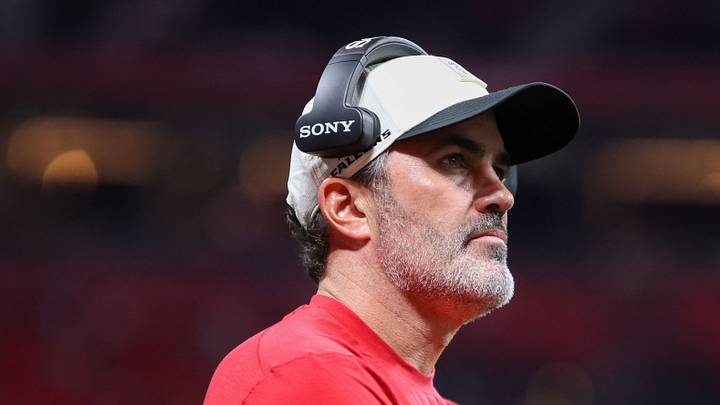
The NFL's roster release deadline is in the books, and for the first time under this new regime, the Atlanta Falcons whittled down their roster from 90 players to the initial 53 on Sunday. The Kevin Stefanski era is in full force, and we now have a better idea of the direction this team is headed in.
You can learn about a head coach by dissecting their roster strategy, and Stefanski's is different from previous Falcons coaches. We're not in the Minor Leagues with Raheem Morris anymore. We essentially skipped Double-A and Triple-A, and we're being thrown into the fire in the big leagues.
We spent all offseason wanting to see this team forge the culture that was lacking under Morris. To play with some physicality, some toughness, and to find a world where coaching won't be the thing holding this franchise back from their playoff drought. All offseason long' we've been waiting to see this team be forged in Stefanski's vision--and now 53 names are currently up for the task.
Since we spent enough time speculating about what would happen to the point we made A Beautiful Mind proud, we finally have some answers. And with that in mind, these three takeaways stood out the most amid Stefanski and Ian Cunningham's first 53-man roster with Atlanta.
Falcons' final 53 makes it clear where Kevin Stefanski is taking this team
3. The Falcons are prioritizing seniority over youth
Someone get ready for the retirement home. With an average roster age of 27.4, the Atlanta Falcons boast the NFL's oldest roster at the moment. And despite the young nucleus this roster possesses, the older players are offering depth and an extra experience to this team that wasn't here before.
Naturally, Jake Matthews and Za'Darius Smith are raising the team's natural roster age, but P-Squadding young UDFAs like Vinny Anthony, Carlos Allen Jr., and Cash Jones is interesting--especially when 31-year-old Mike Ford Jr. and 32-year-old Cooper Rush stayed on the initial 53.
Youth is becoming the name of the game in the modern NFL, but Stefanski is pushing back on that sentiment. The Falcons pursued position battles between youth and experience all offseason long, and in most instances, this new regime chose to invest their trust in the established product.
2. He isn't scared to pull the plug on a failed addition
The most frustrating thing that prior Falcons regimes did was continually hitched their wagons to players who the fanbase knew weren't working out. This was the most bad with Morris and Terry Fontenot, but Stefanski and Cunningham are proving they're the decision-makers we deserved.
The Falcons signed players such as Tyler Goodson, Darnay Holmes, Chris Williams, and Azeez Ojulari during free agency--and released all of them during final cuts. And while two of them were retained on the practice squad, them being cut to begin with is evidence of the change in leadership in Atlanta.
The most egregious example of this is with Wanya Morris. The Dirty Birds acquired him and a 2027 seventh-round pick from Kansas City in exchange for a 2027 sixth-rounder. You'd think off that alone he'd be a roster lock, but after he got injured at the start of camp, Michael Jerrell and seventh-round rookie Ethan Onianwa locked up the backup tackle jobs and there was no room for Morris.
You want a regime that's willing to make the moves necessary, but aren't blinded by them to the point that they won;t cut bait when they realize it's
1. The roster played into its strengths
It doesn't feel super major, but the Atlanta Falcons aren't conforming to NFL standards with their roster-building. Instead of rostering more people at a posotion of weakness, they'd rather keep things really thin at those weaker positions while keeping more people around at some stronger positions.
For instance, the initial 53-man roster rostered just three edge rushers: Za'Darius Smith, Samson Ebukam, and Cameron Thomas--and Azeez Ojulari and Bralen Trice were released. And while they did claim Jared Ivey for a fourth-edge rusher, they still rostered 13 defensive backs on their initial roster.
Yes, both Jammie Robinson and Natrone Brooks have been released in corresponding moves to even out the numbers, but both DB positions were two of the deeper positions on this roster. This new regime wants every roster spot to count, going to a player who earned their spot than to someome by default.
 Add us as a preferred source on Google