

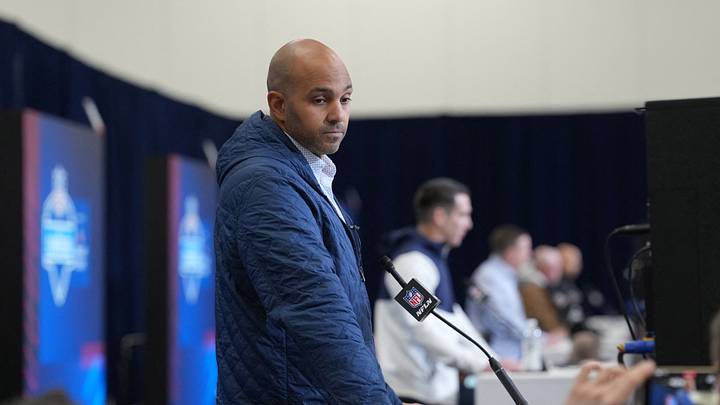
Ian Cunningham has made a myriad of major moves over the course of his ten and a half month tenure as the general manager of the Atlanta Falcons. For starters, there's the six trades he's made and the sale at the deadline, but he's also locked down several members of Atlanta's young core.
He's solidified long-term extensions with the key franchise players, Drake London, Bijan Robinson, Matthew Bergeron, and Kyle Pitts, while most recently retaining high-motor depth contributors Cameron Thomas and C.J Henderson. And he turned the Gervon Dexter Sr. trade into a fruitful extension as well.
After reviewing all the deals he's signed, a trend started to take form. The majority of Cunningham's contracts utilize void years and an overwhelming amount of guaranteed money. That's an art he picked up under Howie Roseman in Philadelphia, and something Bryce Johnston specializes in.
This trend created an interesting subject on how NFL GMs weaponize these financial strategies and systems like guaranteed money to create flexibility for the future.
How an NFL contract comes together as a whole
If you want to understand how general managers like Ian Cunningham manipulate contracts to create flexibility, you must first understand the fundamentals of an NFL contract. The core meaning stands as a formal agreement with the team and player that entails how much they get paid and for how long. A contract is built on a bevy of separate components including:
The years, which is the amount of time the player is contracted. The signing bonus, spread evenly across the contract, it represents money that the player gets right then for signing. Base salary, the amount of money that is guaranteed per the year and is the most flexible part of the contract.
Guaranteed money, which is the amount of money obligated to the player by the team, that will follow them through trades and be dealt as instant cap hit if their cut. There's much more to explore about contracts as a whole alongside this. I'd highly consider taking a look at front office pros for an even deeper dive.
Now that the understanding for an NFL contract is there, the idea of how to manipulate contract money to create cap space, and open up money for now/ future deals comes into play.
Special techniques general managers use to create future cap flexibility
NFL general managers have to play a dangerous game with every contract as they weigh the value of the players and personnel to the money they are spending. With a strict salary cap of $301.2 million per club in 2026, there is no room for error.
Contract restructures are a big way that general managers flex money into the future. In the NFL the base salary hits the cap every year. Like I said before the base salary is considerably flexible within the contract and here's how. NFL GMs can opt to restructure a deal by taking the base salary for the year and converting it to signing bonus. The plus of this is that one can then spread the signing bonus out up to five years, in turn reducing the immediate cap hit that a contract holds over you.
Next is the idea of void years. These are basically non-existent to the contract other than within the year's portion but act as an extra year to use in restructuring deals. They help in creating more space and flexibility to move money.
GMs utilize the draft amongst smaller value contracts in order to keep key players and stay within the NFL's salary cap. Luckily for those struggling the NFL increases the cap every year which has its list of factors associated with it too.
Ian Cunningham has utilized these strategies and more in just a short time with Atlanta; whether it was signing Drake London to a $141 million extension with $100 million guaranteed over four years --creating the potential for an effective restructure--or enacting the restructure of Chris Lindstrom, freeing up $11.76 million in 2026 salary cap space via converting the base salary to signing bonus.
This is how the Falcons plan to be successful as they continue to grow their franchise around the pillars of value and financial ingenuity.
 Add us as a preferred source on Google