

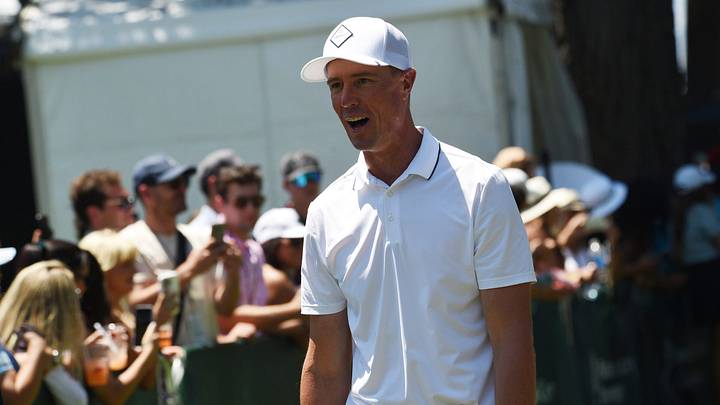
One of the first indicators that the Falcons are operating in a different way under new President of Football Matt Ryan can be found in the structure of their recently inked extensions. Between Bijan Robinson's historic extension and Drake London's large deal, another recently hired executive's fingerprints are all over how the Falcons do business these days.
In April, Ryan and general manager Ian Cunningham hired Bryce Johnston as Vice President of Football Administration/Senior Personnel Executive. Johnston had previously worked in the front office of the Philadelphia Eagles for over a decade, where he was Howie Roseman's main cap guy.
In Philadelphia, where Johnston originally met and worked with Cunningham, he was a part of a contract strategy designed to maximize cash spending and minimizing early cap hits.
Bryce Johnston is the hidden key to the puzzle for the Falcons' contracts
Until recently, most multi-year veteran contracts in the NFL contained a small year one salary, a large prorated signing bonus and large salaries in years two and beyond. That minimized the year one cap hit of the contract. If the team needed to reduce the cap hit for that player in subsequent years the team had to ask the player for permission to restructure their contract.
This was always a matter of formality as players have every incentive to approve restructures (it increases the likelihood they remain on the roster through the end of their deals). But the Eagles started using a model that circumvented the request, maximized cap flexibility and helped them turn into one of the highest spending teams in the NFL.
Bryce Johnston is using option bonuses with the Falcons
The Eagles have used option bonuses for years now. These act in the same way signing bonuses do in how they are treated within the salary cap. Using Robinson's deal as an example, the Falcons will pay their star running back the following by year:
Year | Cash |
|---|---|
2026 | $18,744,348 |
2027 | $8,323,000 |
2028 | $10,500,000 |
2029 | $22,000,000 |
2030 | $22,250,000 |
In 2026 only $1,145,000, which is the minimum base salary they can pay a player with his three years of service time. They are also paying him $2,599,348 in a roster bonus. Both of those vehicles hit the Falcons 2026 salary cap at a 1:1 ratio.
The remaining $15,000,000 of Robinson's earnings this year come in the form of a signing bonus that is prorated from 2026 through 2029 at $3,000,000 per year as far as the salary cap is concerned. After adding in the remaining proration of his rookie signing bonus his 2026 cap hit comes in just over half of his cash earnings this year at $9,986,810.
This is all pretty standard. Where it stops being standard for most teams in the NFL is what happens in 2027 and beyond. Next year the Falcons will once again keep Robinson's base salary at the league minimum for his service time - $1,260,000. The remaining $7,063,000 they owe him will be an option bonus that will prorate for cap purposes over 2027-2031. The Falcons don't have to ask Bijan for permission to convert the bonus while enjoying $5,650,400 in cap savings in 2027.
Atlanta repeats this for the remainder of the contract all the way through 2030, setting void years for 2031-2034 to maximize the future prorations. This does put them in a position to potentially absorb $32,846,600 in dead cap in 2031 if they don't extend Robinson prior to his contract expiring.
Why the change
The Eagles and other teams like them use this strategy to maximize cash spending. This year's salary cap is $301.2 million. As of this writing Philadelphia is third in cash spending for 2026 at just over $390 million. Spending 30% above the cap is only possible if they reduce the salary cap hits as much as possible. The money that pushes into the future is discounted because the salary cap rises year-to-year.
The Falcons don't need to take this strategy based on where they are right now. Their cash spending this year is actually lower than the salary cap. But it does point to what their strategy will be going forward. Low cap hits and maximum flexibility to allow Ryan and Cunningham to go big game hunting when they feel like the roster is ready to truly compete for the NFC South crown and more.
The Eagles have been able to retain top talent at an almost unfair rate. Just this year they have 13 players making $10 million or more, five over $20 million, of which Jalen Hurts is clearing $50 million. If the Falcons execute that same strategy, it will put them into a new level of competitiveness and give them a clear advantage over the Bucs, Panthers and Saints.
It's a new day in Atlanta. And it looks like the future may bring brighter days ahead.
 Add us as a preferred source on Google